
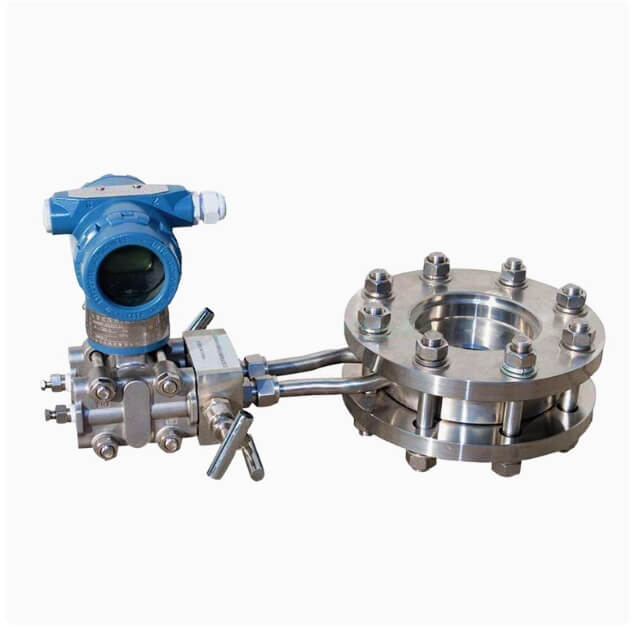

Introduction
Balanced orifice flowmeter (also known as multi-hole orifice plate or differential pressure flowmeter) is a new type of throttling flow sensor developed on the basis of standard orifice plate and flow regulator. It is suitable for installation downstream of various disturbance sources and provides excellent performance with the shortest straight pipe section. It is mainly used to measure the flow of gas, steam, liquid, gas-liquid two-phase flow, liquid-gas, bidirectional flow, dirty media and slurry, and is widely used in process control and measurement in the fields of petroleum, chemical industry, metallurgy, electric power, light industry, textile, scientific research, military industry, heating, water supply, etc.
Advantages
●Resistant to dirt and not easy to clog;
● Wide range ratio, up to 10:1;
● Can measure complex working conditions;
● Low requirements for straight pipe sections, generally 3D in front, 1D in the back, and the minimum can be less than 0.5D;
● Good long-term stability, the whole set of instruments has no moving parts and can maintain stability for a long time;
● Can measure high-temperature and high-pressure media, the working temperature can reach 850℃, and the working pressure can reach 42MPa;
● The orifice plate can be directly replaced, which is very suitable for replacing the orifice plate with a balanced flowmeter in the energy metering transformation of the whole plant;
● High linearity, good repeatability, greatly improved flow field stability, and linearity is 5 to 10 times higher than that of the standard orifice plate.
Balanced flowmeters are mainly used to measure the flow of gas, steam, liquid, gas-liquid two-phase flow, liquid-gas, bidirectional flow, dirty media and slurry. They are widely used in process control and measurement in the fields of petroleum, chemical industry, metallurgy, electricity, light industry, textile, scientific research, military industry, heating, water supply, etc.
The working temperature and pressure of the balanced flowmeter depend on the material and grade of the pipe and flange. The working temperature can reach up to 850℃ and the pressure can reach up to 42MPa.
The balanced flowmeter is suitable for extremely low temperature fluids such as liquefied natural gas (LNG), liquid air, liquid nitrogen, liquid oxygen, liquid argon, liquid ethylene, liquid hydrogen, liquid chlorine, etc., effectively preventing gasification and achieving the best measurement effect.
The balanced flowmeter can measure gas-liquid two-phase flow, slurry, and even fluids containing solid particles, and can also measure bidirectional flow.
The balanced flowmeter is completely symmetrical on the left and right, so it can easily measure bidirectional flow.
1. Pipe diameter range: DN15~DN1000+;
2. Accuracy: ±0.3%, ±0.5%, ±1%;
3. Straight pipe section requirements: 0.5D~2D;
4. Permanent pressure loss: 1/3~1/4 of the orifice plate;
5. Range ratio: 10:1, applicable to a wider range of working conditions;
6. Repeatability: 0.1%;
7. Reynolds number range: Re 200~107;
8. β range: 0.25~0.9;
9. Temperature range: The maximum temperature resistance of metal pipes can reach 850℃;
10. Pressure range: The maximum pressure resistance of metal pipes can reach 42MPa;
11. Anti-scaling ability: special design calculation;
12. Measuring bidirectional flow: The balanced flowmeter is completely symmetrical on the left and right.
Installation
Be sure to clean the pipeline before installation: the new pipeline must be flushed and cleaned first to prevent debris from clogging or damaging the orifice plate.
Check the orifice plate parameters: Check whether the number, specifications, pipeline conditions, and flow range of the orifice plate are consistent to ensure the correct selection.
The direction mark is installed correctly: the "+" end is connected to the upstream of the fluid, and the "-" end is connected to the downstream. The acute angle surface must face the direction of the fluid.
The center line is strictly aligned: the center line of the orifice plate is coaxial with the center line of the pipeline, and the deviation is controlled within the allowable range.
Requirements for pipelines and straight pipe sections: Straight pipe section length specification: the upstream side must be at least 10 times the pipe diameter (10D) long, and the downstream side must be at least 5 times the pipe diameter (5D).
If there are interference sources such as elbows and valves, the straight pipe section needs to be appropriately extended.
Straight pipe section roundness control: within the 2D range before the throttling device, the inner diameter deviation shall not exceed ±0.3%; the rear deviation shall not exceed ±2%.
Pressure sampling and accessories installation:
Pressure port location selection:
The gas measurement pressure port is located above the pipeline, the liquid measurement pressure port is located below the side, and the steam measurement requires a condenser.
Pressure pipe installation specifications:
Keep the pressure pipe parallel, with a slope of not less than 1:10, to avoid bubbles or liquid accumulation affecting the measurement.
Other precautions:
Avoid installation in extreme positions: It is not recommended to install at the highest or lowest point of the pipeline to prevent medium accumulation.
Sealing gasket restrictions: The thickness shall not exceed 0.5mm, and shall not protrude into the inner wall of the pipeline.